Having Takuya recommended to us by Osaka locals was a highlight of our trip. Professional, knowledgeable of both historical fact and current affairs , combined with his ability to fine tune his tours to our special interests maximized our time in both Osaka and Kyoto.
Discover the Real Osaka — Away from the tourist trail, into the suburbs most travelers never see
Exclusive Local Experiences — Fish auctions, matchlock muskets, wine country & ancient kofun tombs
Fully Customizable Private Tour — Full-day, built around your interests and pace
DISCOVER THE REAL OSAKA — BEYOND THE TOURIST TRAIL
Escape the fabricated tourist trail. On this private Osaka suburban tour, I take you to destinations that most travel companies have never heard of — places where the real Osaka, and the real Japan, quietly exist.
These are not hidden in the sense that they are secret. They are hidden because no one bothers to take you there. Until now.
Ikeda — Where Instant Ramen Was Born
I can begin our Osaka suburban tour in Ikeda, the birthplace of instant ramen — ranked alongside karaoke and conveyor belt sushi as one of the three greatest modern inventions to come out of Osaka. At the Instant Ramen Museum, you create your own original Cup Noodle from scratch, a hands-on experience that surprises even the most seasoned Japan travelers.
Minoh — Waterfalls, Wild Monkeys, and Autumn Foliage
Just 25 minutes from Umeda, Minoh feels a world apart from the city. I walk with you along the clear Minoh River, through a canopy of maple trees, to the beautiful 33-meter Minoh Waterfall — one of Japan’s top 100 waterfalls. In autumn, the trail turns a breathtaking red and gold.
Near the waterfall, you may encounter wild Japanese snow monkeys. A word of caution: do not stare them directly in the eye, as they may interpret eye contact as a challenge.
From Minoh, I can extend our tour to Katsuoji Temple — the legendary “Temple of Victory.” Thousands of red Daruma dolls line the temple grounds, each one placed by a visitor whose wish came true. The atmosphere is unlike any temple in Kyoto or Nara.
Note: Katsuoji Temple requires a short taxi ride from the waterfall area. I handle all logistics.
Toyonaka — A Journey Through Japan’s Architectural History
Inside the vast Hattori Ryokuchi Park in Toyonaka lies the Minka-shurakumuseum (Open-Air Museum of Old Japanese Farm Houses) — a collection of beautifully preserved traditional farmhouses relocated from across Japan. Each structure tells a different story of regional life. I take you through this extraordinary place, one of the most quietly rewarding stops on any Osaka suburban tour, yet virtually unknown to international visitors.
Suita — Inside the Tower of the Sun
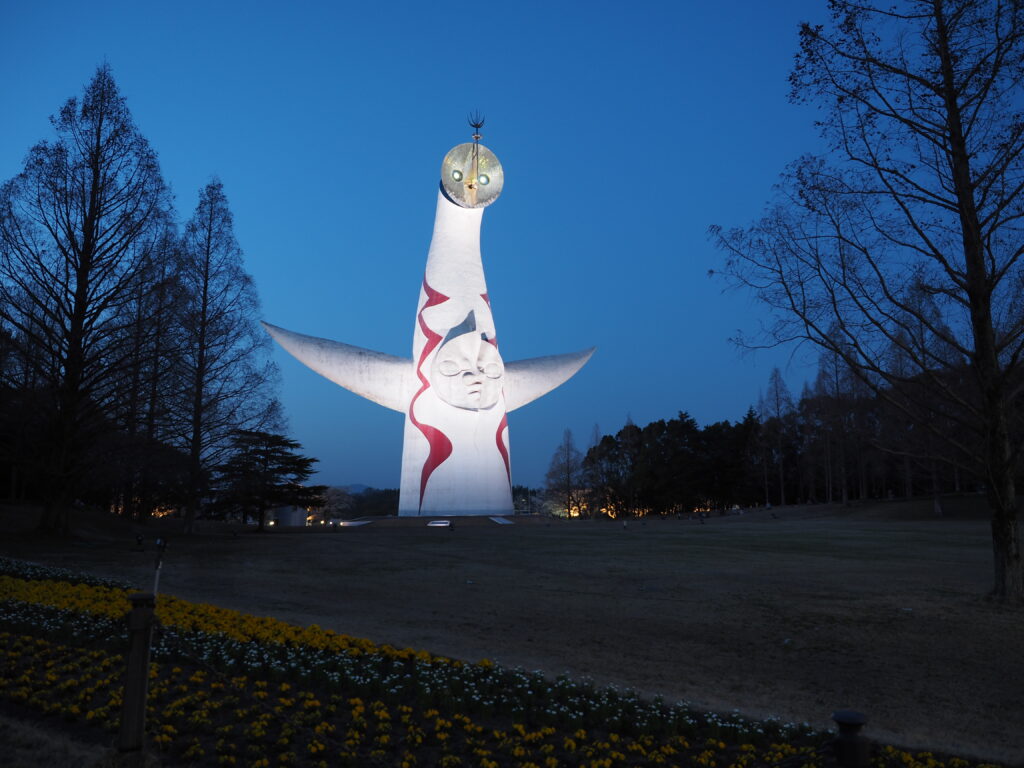
“Art is an explosion.” So declared Taro Okamoto, one of Japan’s most radical artists. His masterpiece, the Tower of the Sun, rises dramatically from Expo Commemorative Park in Suita — a relic of the 1970 World Exposition that seems to defy both time and logic.
Entry to the tower interior requires advance reservation and is subject to availability. When access is secured, I guide you inside, where Okamoto’s monumental “Tree of Life” sculpture climbs 41 meters into the sky, tracing the evolution of life on Earth — an experience that is genuinely difficult to describe.
Note: Interior access cannot be guaranteed. Even if interior entry is not available on the day, the exterior of the Tower of the Sun and the surrounding park are extraordinary in their own right.
Nose — Mountain Temples and Sacred Horses
For those who love nature and spiritual culture, I can extend our tour all the way to Myokenzan in Nose. Here, a historic Buddhist temple crowns the mountain, while a nearby Shinto shrine keeps a resident sacred horse — an animal believed to serve as a messenger of the gods. Few international visitors ever make it this far north of Osaka. That is precisely the point.
Sakai — Kofun Tombs, Knives, and the Birthplace of the Tea Ceremony
Sakai is the most historically layered city in Greater Osaka, and one of the most rewarding stops on any off the beaten path Osaka tour.
The Mozu Kofun Cluster, a UNESCO World Heritage Site, contains some of the largest burial mounds on earth. The tomb of Emperor Nintoku is larger in surface area than the Great Pyramid of Giza — yet because these mounds are protected as imperial property, no one may set foot inside them. The most dramatic way to grasp their true scale is from above: I arrange a tethered helium balloon ride that rises 100 meters into the sky, revealing the unmistakable keyhole shapes of the ancient tombs spread across the modern city below.
Sakai is also the city where Japanese knives were born. In the historic Teppocho district, I take you to working knife workshops where craftsmen continue the centuries-old techniques that have made Sakai blades famous among professional chefs worldwide.
Also in Teppocho stands the Sakai Teppokan — a remarkable private museum dedicated to the history of Japanese firearms, run entirely by volunteers and led by the passionate curator Hideo Ida, who transformed a 100-year-old machiya townhouse into a living record of Sakai’s gunmaking heritage.
Here, I invite you to don a traditional samurai helmet and jinbaori coat and hold a genuine matchlock musket. Under Japanese law, firearms are strictly regulated — but these matchlock muskets are classified as historical artifacts under the oversight of the Board of Education, which means that visitors are permitted to handle them. You will feel — viscerally — how heavy it was to march into battle carrying one. It is one of the most unexpectedly moving experiences I share with my guests, and one that is simply not possible anywhere else.
Note: Sakai Teppokan is open on Sundays only (11:00–16:00), with summer and winter closures and occasional unscheduled closures. Admission is ¥100. I will confirm availability for your chosen date at the time of enquiry.
And it was in Sakai that Sen no Rikyu, the grandmaster of the Japanese tea ceremony, perfected the philosophy of wabi-cha. I take you to enjoy a bowl of matcha in Sakai — not as a tourist activity, but as a return to the source.
Kishiwada — A Castle and Japan’s Most Aggressive Festival
South of Sakai, I show you Kishiwada Castle, which stands with one of Japan’s most unusual castle gardens, designed by the celebrated landscape architect Shigemori Mirei. The garden is a bold reinterpretation of classical Japanese design — stark, geometric, and unlike anything you will see in Kyoto.
Kishiwada is also famous for the Danjiri Festival, held each autumn, when enormous wooden floats weighing several tons are pulled through the streets at full speed by teams of hundreds. It is one of the most thrillingly aggressive festivals in Japan. If your visit coincides with the festival season, I strongly recommend including it in our itinerary.
Izumisano — The Midday Fish Auction at the Wharf
At Izumisano Wharf, I take you to one of the most unusual experiences on this Osaka suburban tour: the hiruami, or midday fish auction. Boats return to port at noon, and the freshly caught fish are unloaded and carried directly to the auction floor by the fisherwomen of the harbor. This type of daytime auction is found almost nowhere else in Japan.
After the auction, we can buy and eat the same fish at the restaurant beside the wharf — as fresh as it is possible to be.
Tondabayashi — A Time Slip to 16th-Century Japan
If Kyoto feels overcrowded and overpolished, I take you to Tondabayashi — a place that offers something rarer: authenticity without the audience.
The Jinaimachi historic district is a perfectly preserved merchant town from the 16th century. Walking its lanes together, you see the same streetscapes, the same wooden lattice facades, the same proportions of light and shadow that existed here 400 years ago. Unlike Kyoto’s most famous districts, there are no crowds, no souvenir shops, no coach parties. Just Japan, as it was.
Jinaimachi is a nationally designated Preservation District for Groups of Historic Buildings — one of the most significant in the Osaka region, and one of the least visited by international travelers.
Habikino — Osaka’s Wine Country
Who would expect to find wine country in Osaka?
In Habikino, I show you a landscape that shifts unexpectedly: vineyards on the hillsides, and the Kawachi Wine winery, which has been producing red and white wine here since 1914. When the winery president is available, he personally guides us through the historic cellars — a rare privilege I am pleased to offer my guests. After the visit, we taste the wines together, including the plum wine, which has developed a devoted following among my international guests who encounter its delicate sweetness for the first time.
Note: The personal winery tour with the president depends on his availability on the day and cannot be guaranteed. A visit to the winery and tasting are available regardless.
This is one of the most surprising stops on any Osaka suburban tour, and one of the most memorable.
Book Your Private Osaka Suburban Tour
These are not places you stumble upon. They require local knowledge, advance reservations in some cases, and the ability to navigate Japan confidently in Japanese. With over 30 years of experience and a National Government License as a Guide Interpreter, I bring not just directions, but context — the history, the stories, and the human connections that turn a day trip into an experience you will not forget.
I design every itinerary around your interests and pace, whether you want a half-day in Minoh, a full day in Sakai, or a journey across multiple areas of suburban Osaka.
Please note: Some experiences described on this page — including Tower of the Sun interior access, Sakai Teppokan, and the Kawachi Wine winery tour with the president — are subject to availability, opening schedules, or seasonal closures. I will confirm what is possible for your chosen date at the time of enquiry.


Highlights
Sakai kofun tombs (UNESCO) viewed from a hot air balloon — the largest burial mounds on earth
Tondabayashi Jinaimachi — a perfectly preserved 16th-century merchant town, without the crowds
Izumisano hiruami — a midday fish auction unique to Osaka Bay, followed by lunch at the wharf
Click the tabs to find out more...
Trip Details
Trip Details
Price
JPY70,000.- and up
Departure time
9AM
Meeting point
To be determined with guests
Availability
Throughout year (Except the period of New Year Holiday)
Duration
7 hours
Group size
Min. 1 person (up to 4 Pax.) (Inquire the guide rate for the guests over 5.)
Included
Guide fee
Not included
Transportation, Meals, Entrance fees etc.
The expenses of the Tour Guide (The same as the guests)
What to bring
To be determined with guests
Number & type of staff for tour
Award winning National Licensed Tour Guide Interpreter in English
Recommended Sample Itineraries

- Meet at your hotel
- We take you by train to Ikeda — birthplace of instant ramen
- Instant Ramen Museum: create your own original Cup Noodle from scratch
- Transfer to Minoh — walk the scenic river trail to the 33-meter Minoh Waterfall
- Watch for wild Japanese snow monkeys near the waterfall
- Continue by taxi to Katsuoji Temple — the legendary “Temple of Victory,” lined with thousands of red Daruma dolls
- Return to your hotel
See What My Previous Guests Say
Our family for 4 had the good fortune of having Takuya-san as a guide in Osaka for a day. Since language is a barrier to self planning in Japan, having Takuya helped immensely, especially since we had some unusual requests like visiting a pet beetle shop and watching the Keren Show.
We kicked the evening off at a cozy Izakaya bar. Takuya, of course, ordered a great mix of dishes for us. We then hit a variety of restaurants in all sorts of neighborhoods. We tried foods we never would have tried, in restaurants we never would have visited.
Check Out My Other Private Tours of Japan


Osaka Suburban Tour: Hidden Gems Beyond the City Center
An Osaka suburban tour reveals a side of the Kansai region that most visitors never discover. Within thirty to sixty minutes of Osaka’s city center lie some of Japan’s most extraordinary yet least-visited destinations — ancient mountain temples, feudal castle towns, sake brewery districts, and landscapes of quiet rural beauty that stand in complete contrast to the urban energy of Dotonbori and Namba. As a nationally licensed guide interpreter based in Osaka, I have spent decades exploring these surrounding areas and know exactly which hidden corners are worth the journey.
Every Osaka suburban private tour I design is built around your interests. Whether you are drawn to history, nature, traditional crafts, sake culture, or simply want to experience an authentic side of Japan that the standard tourist circuit never reaches — I create the day around what matters most to you.
Highlights of the Osaka Suburban Tour
- Yoshino — Japan’s most celebrated cherry blossom destination, a mountain village in Nara Prefecture where over 30,000 cherry trees cover the hillsides in a cascade of pink and white each spring. Outside blossom season, Yoshino offers ancient temple complexes, pilgrimage trails, and extraordinary mountain scenery.
- Kashihara and Asuka — The birthplace of Japanese civilization, where the country’s first emperors established their courts and where megalithic stone monuments, ancient burial mounds, and early Buddhist temples preserve the origins of Japanese culture. Largely unknown to international visitors.
- Sakai — Osaka Prefecture’s second city, once the most prosperous merchant port in medieval Japan and the birthplace of Sen no Rikyu, the founder of the Japanese tea ceremony. The city’s blade-making tradition, which dates back over 600 years, continues today in workshops that supply professional chefs across the world.
- Minoh — A forested valley just north of Osaka, famous for its autumn foliage and a 33-meter waterfall reached by a trail lined with maple trees. A perfect half-day escape from the city into nature.
- Ikeda — A quiet residential city north of Osaka with a beautifully preserved samurai district, traditional craft workshops, and the birthplace of Cup Noodles — home to the Instant Ramen Museum where visitors can design their own custom ramen cup.
Why Choose a Private Guide for the Osaka Suburbs
The destinations surrounding Osaka require local knowledge to visit effectively. Transport connections, opening hours, seasonal timing, and the cultural context behind each site are all factors that determine whether a day trip succeeds or disappoints. On an Osaka suburban tour with me, every detail is handled — and every stop delivers something genuinely memorable. I have guided these areas for decades and bring not just knowledge but genuine enthusiasm for sharing parts of Japan that most visitors never find on their own. The rewards for venturing beyond the city center are consistently extraordinary — and consistently underestimated by those who stick to the standard Osaka, Kyoto, Nara circuit.
These tours work well as standalone days from Osaka and can be combined with visits to Nara, Kyoto, or other destinations as part of a longer multi-day private tour of Japan. Each destination in the Osaka suburbs has its own optimal season — Yoshino in cherry blossom season, Minoh in autumn foliage, Asuka in early summer when the rice fields are green and the ancient stones are at their most evocative. I help you choose the combination that best matches when you are visiting and what you most want to experience. For booking details, visit the FAQ page or contact me directly to begin planning your Osaka suburban tour.
Read what past guests have said about their Osaka suburban private tour experience with me on my TripAdvisor page(opens in a new tab).